Russia’s ‘Soft Power’
Culture as a Weapon
Chapter 2: Russian Culture in the Service of War — Political scientist Martin Malek examines the projection of influence through Russian culture and its representatives abroad
Martin Malek • 24. Februar 2026
OPERN∙NEWS provides this article free of charge.
Sign up and become a donor to support our journalistic work!
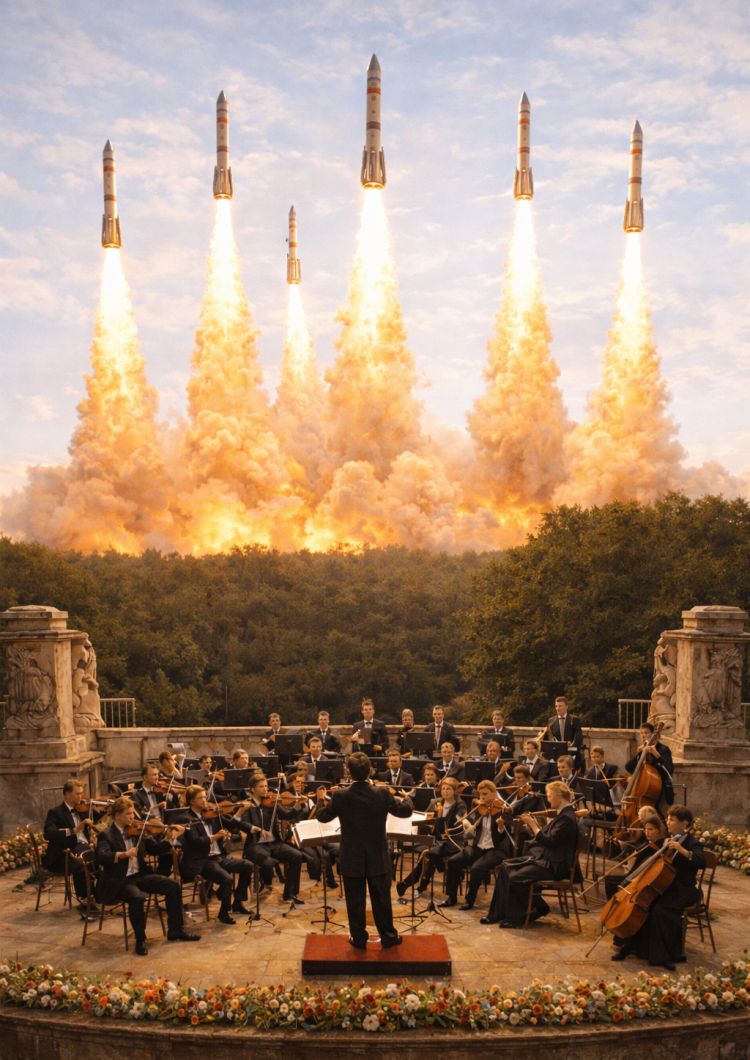
Russia-born author Mikhail Shishkin, who has lived in Switzerland since 1995, said: "All dictatorships abuse culture to ‘decorate' their crimes." [54] Unsurprisingly, Putin's Russia was and is no exception – and the war against Ukraine is exacerbating the situation. Anne Applebaum said in July 2025 (when she also gave the opening speech at the Salzburg Festival of music and drama) that the eradication of Ukrainian culture was one of Moscow's war aims. The Russian attackers are "aware of how the destruction of culture can at least help to destroy or undermine a country and a nation." [55]
The Kremlin has placed significant parts of politics, media, business, science, and even culture at the service of its war against Ukraine. The latter includes film production for television and cinema, theaters (with films and plays supporting or glorifying the war against Ukraine being shown in Russia and the occupied territories of Ukraine), museums, exhibitions, etc. [56] All of this is happening with virtually no resistance from Russian [rossiiskoe] society, where there are not even traces of an anti-war movement. On the contrary, hundreds of thousands have volunteered to fight against the hated Ukraine. This fact cannot be explained solely by the regime's (undeniable) repression.
And it is ignored by (almost) everyone in "the West" who constantly invokes and celebrates "great Russian culture." It doesn't bother them, let alone prompt them to protest. And coincidentally or not, these are often the same people, media outlets, groups, and organizations that, even after 2022, continue to demand that "Russia's security interests" be taken into account (while demonstratively ignoring the security interests of Ukraine, whose very existence is currently threatened by Russia). Those in "the West" who believe they must fight against a "Netrebko boycott" or even a whole "boycott of Russian culture" (although neither ever existed) have rarely, if ever, cared about the destruction and damage to Ukrainian cultural sites (including the Kharkiv Opera House and the Music and Drama Theater in Vinnytsia) by Russian bombing.
It is particularly absurd that Russia constantly complains about a "boycott of Russian culture in the West" while at the same time seeking to eradicate Ukrainian culture, identity, and language, as has been evident in the occupied territories of Ukraine since 2014. This contradiction stubbornly escapes the notice of those politicians, journalists, social scientists, cultural figures, managers, etc. in "the West" who equally condemn such a "boycott."
And the reference to "great Russian culture," which Moscow and its sympathizers and henchmen in "the West" constantly invoke, is, of course, intended to distract attention from Russia's war crimes in Ukraine. Many voices and actors in Russia and "the West" will naturally deny this indignantly, but that does not change the facts.
In view of Putin's extremely nationalistic, imperialistic, and militaristic autocracy and the war of annihilation against Ukraine since 2022 phrases such as "culture connects people," "culture transcends borders," "culture is international," "culture builds bridges," etc. are now nothing more than hollow and meaningless, not to say tragicomic. One of the best-known historians of Eastern Europe in the German-speaking countries, Karl Schlögel, called for a change of perspective: "You can't watch the war and at the same time say: 'But there is the great Russian culture.'" The Russian [rossiiskii] aggressor would also use cultural figures against Ukraine. "It will take an awfully long time for Russian [russkaya] culture to recover from this contamination and instrumentalization by the war after it ends – if it ever does." [57]
Philipp Ther, professor of Eastern European history at the University of Vienna, believed that in view of Russia's "destructive fury" in Ukraine, it was "important for the West [...] to become more open to Ukrainian culture than it has been in the past." [58] Opera houses and concert halls in the EU and North America could have responded to Russia's war of aggression by promoting Ukrainian artists (including those who had to flee Russian bombs) and also by including more works by Ukrainian composers in their programs. There is excellent Ukrainian music that is hardly known in the world for several reasons (Russia's imperial influence is not the least significant).
At least Dmytro Bortniansky (1751–1825; a representative of the "Ukrainian Baroque"), Borys Lyatoshynsky (1894–1968; the "Ukrainian Brahms") and Mykola Lysenko (1842–1912) should be mentioned here. The latter wrote excellent operas (including «Taras Bulba» and «Natalka Poltavka»), which are completely unknown in Western Europe. It doesn't always have to be Tchaikovsky's The «Queen of Spades» or Modest Mussorgsky's «Boris Godunov»! One would also hope for much more interest in Western Europe in the modern Ukrainian school of composers, whose best-known representative is probably Valentyn Sylvestrov, although Lesya Dechko, Yevhen Stankovych, Myroslav Skoryk, Ivan Nebesnyy (and others) also deserve attention. Not to be overlooked is the opera «Vyshyvanyi. The King of Ukraine», created by composer Alla Zahaykevych to a libretto by Serhiy Zhadan, an author well known in German-speaking countries as well (which premiered in 2021 in Kharkiv).
All this should be noted against the backdrop of Russia's desire to eliminate the Ukrainian nation and, inevitably, its culture. This did not begin in 2022, but is a clear trend that can be traced from the Tsarist Empire's attempts to ban the Ukrainian language, through the Soviet Holodomor of 1932–1933 (most estimates of the number of people who starved to death at that time range from 3.5 to 5 million in Ukraine alone) to Putin's current "special military operation," in the course of which the Russian army is also and specifically bombing energy supply facilities for civilians in order to freeze them in winter at temperatures of -20°C or even lower (incidentally, largely without outrage in "the West", not to mention countermeasures against Russia). Ukrainian author Natalka Sniadanko, who had to flee to Germany because of the war, said: "The great Russian culture has always been enforced in Ukraine with blood and violence." [59]
Influence projection through Russian culture abroad: The case of Gergiev
After 2014, but especially after 2022, culture is, from the perspective of Putin's Kremlin, yet another battlefield in the ‘hybrid war' against "the West" and Ukraine to which he is sending his ‘troops.' This is where Russian artists who are successful in "Western" countries also and especially come into play. The Kremlin tries (with some success) to win them over. It is also important to him that these artists take direct political action of various kinds, make statements, sign petitions, etc.
A particularly serious case is that of conductor Valery Gergiev (an important patron of soprano Anna Netrebko, who has lived in Vienna for many years [60]). He first appeared at the Salzburg Festival in 1997 (where he conducted «Boris Godunov»). Gergiev has conducted the Vienna Philharmonic's Summer Night Concert at Schönbrunn Palace (Vienna) more often than anyone else. [61] In 2004, he made his debut at the Vienna State Opera (with a "Concert for Austria"; he conducted his first opera, Richard Wagner's «Parsifal», there in 2019); his last appearance there to date was on January 30, 2022 (less than four weeks before Russia's large-scale invasion of Ukraine). The State Opera's website still states that Gergiev is "one of the world's most important conductors" and that he has led the Mariinsky Theatre in St. Petersburg "to new splendor." Parallel to his work at the Vienna State Opera, Gergiev became "an indispensable guest at all major international opera houses, at the central festivals, and on the most important concert stages." [62] In an article in the State Opera magazine in 2019 it was stated that Gergiev was "someone who does not shy away from conflict and sometimes takes political sides." And he has "excellent contacts with the Russian leadership."[63] – How true!
Gergiev's statements, and even more so his politically relevant activities could (and should) have provided in "the West" more than enough reasons to ‘part ways' with him long before 2022. He has never made a secret of his views – and the "Western" cultural sector has rewarded him with "offensive blindness." [64] Immediately after Russia's war against Georgia in August 2008, Gergiev conducted a "victory concert" in the separatist province of South Ossetia (which the Kremlin recognized as an "independent state" at the time). In March 2014, Gergiev (along with the highly decorated pianist Denis Matsuev, who is also well known outside Russia) signed an ‘open letter' in which he unequivocally supported Russia's annexation of the Ukrainian peninsula of Crimea, which violated international law.[65]
For reasons unknown, not even this prevented his appointment as chief conductor of the Munich Philharmonic Orchestra in 2015, as well as countless other lucrative engagements in Western Europe and North America in the following years. The ‘separation of art and politics,' which is completely unknown in Putin's Russia but very often portrayed in "the West" as important, even indispensable, was adhered to so strictly that the vast majority of cultural managers simply ignored Gergiev's (and many other Russian artists') politically relevant activities and instead carried on with business as usual. In Russia, this was (also) perceived as a weakness and exploited. This was not made any more difficult by the fact that the books about Gergiev available in "Western" languages presented him in a particularly favorable light. [66]
Igor Levit, a world-renowned pianist who was born in Russia but has lived in Germany since 1995, said that being a musician does not exempt one from civic responsibility. He believes that using one's status as an artist to excuse an apolitical stance is an insult to art itself. [67] No one should ever use "music and being a musician" as an excuse "not wanting to express an opinion on humanitarian issues." [68]
The position of Markus Hinterhäuser, pianist and artistic director of the Salzburg Festival, is also interesting in this context: he did not deny "thinking about culture in political terms." He "does not see how great works of art could ever have been created in a space free of politics." [69] In any case, even after 2022, he continued to invite and promote Teodor Currentzis, a conductor who originated in Greece but ‘rose to prominence' in Russia, even though Currentzis refused to comment on Putin's regime and Russia's war against Ukraine. Fundamentally, Hinterhäuser remains one of Currentzis's "most ardent defenders."[70] Hinterhäuser's unexpected and premature departure from the Salzburg Festival in the spring of 2026 had nothing to do with Currentzis.
The director of the Vienna State Opera, Bogdan Roščić, also has to accept criticism for regularly allowing people to perform at his theater who are also used by the Russian regime. Just last Wednesday—only a few days before the fourth anniversary of Russia’s full-scale invasion—he offered his stage to Anna Netrebko for a solo concert, which angered the Ukrainian ambassador in Vienna. [71] The Vienna State Opera was also the last opera house in the German-speaking sphere to distance itself (or was it forced to distance itself?) from the Russian bass Ildar Abdrazakov after OPERN∙NEWS had already exposed his ties to the “Putin system” months earlier. Furthermore, Dmitry Korchak—who also receives financial support from the Russian government—will be making a guest appearance at Roščić’s opera house in March.
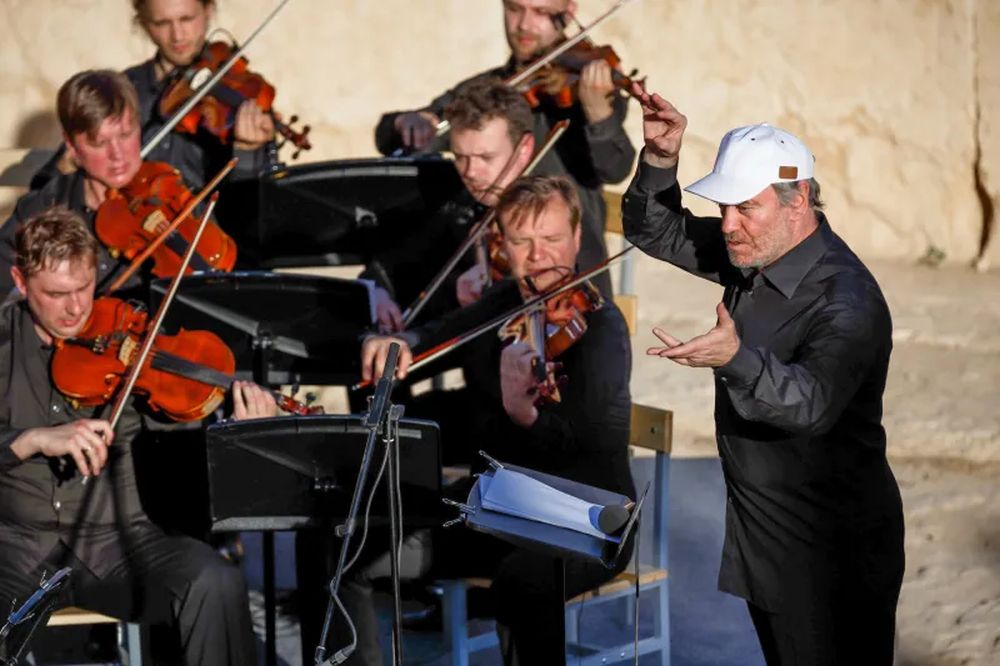
But back to Gergiev: In 2015, Putin initiated a military intervention in Syria, during which the Russian air force deliberately destroyed civilian infrastructure such as hospitals, residential buildings, water supplies, bakeries, etc. and many cities, including Aleppo, which had long been held by opposition forces, were "bombed back to the Stone Age." In this way, Moscow held its ‘protective hand' over Syrian president Bashar al-Assad, who used barrel bombs and chemical weapons against his own people, murdered hundreds of thousands, and drove millions out of the country. What did Gergiev do in the face of all this? In May 2016, he conducted a highly tasteless concert (which was nevertheless – or perhaps precisely because of this – largely ignored in Western Europe) in the ruins of the Syrian city of Palmyra, which had just been occupied by Russian troops.
One of the soloists performing was cellist Sergei Roldugin, whose 'side job' is as one of Putin's 'asset managers.' [72] As revealed in 2016 by the infamous 'Panama Papers,' among other sources, he was involved in the transfer of several billion dollars (!) that some notorious ‘circles close to the Kremlin' had somehow acquired. [73] In February 2022, Gergiev (who has been acquainted with Putin since the 1990s, when Putin was working in the St. Petersburg city administration) did not deign to respond when the mayor of Munich, Dieter Reiter (Social Democratic Party), suggested that he take a stand on Putin's flull-fledged war against Ukraine (which ultimately did cost Gergiev his position as chief conductor).
Putin immediately rewarded Gergiev for his ‘steadfastness' toward "the West": the Kremlin leader proposed the creation of a "joint management" of the Mariinsky Theater in St. Petersburg and the Bolshoi Theater in Moscow, which, of course, no one other than Gergiev himself would be appointed to lead. [74] It goes like this: When our friend Gergiev encounters difficulties in "the West," he climbs (further) up the career ladder here in Russia. Because "we" believe that "the West" is annoyed by this. And furthermore, with such a "joint management" with Gergiev, the Kremlin could "rule until the curtain falls and reduce the repertoire to a minimum, presumably to Russian classics interpreted in a Soviet style, heroic productions, and melancholic fairy tales." [75]
An investigation by the team led by opposition figure Alexei Navalny (who was murdered in 2024 in a Siberian penal colony where Putin's regime had imprisoned him) even placed Gergiev "in the same category as war criminals." This is because, "accompanied by Gergiev's orchestra, rockets explode, Ukrainian cities are destroyed, civilians are shot, and everything that lives is burned. Gergiev's [musical] talent now serves war, death, and destruction." Gergiev's music is also intended to distract from Putin's crimes. Navalny's team further accused Gergiev of massive corruption and demanded that this "conductor of war" be added to the international sanctions lists against Russia. [76] However, only Canada did so; the EU, the US, etc. refrained from this – until today. [77]
Gergiev (who likes to emphasize his "friendship" with Lavrov in public) is one of many people close to the Kremlin and Putin who were or are fully involved in the smear campaigns and propaganda against Ukraine and the "collective West" – and yet still own vast real estate holdings there and sometimes live there permanently (often with the respective citizenship; the passport of the USA, which is otherwise hated in Russia, is particularly sought after) or, like Gergiev, perform for lavish fees. This was possible in particular because, for many years, many Western cultural managers either did not recognize or accepted the role that Gergiev was assigned in the context of Russian foreign cultural policy. If that is not to say that they actively supported it.
Conclusions
Ulrich Schmid, professor of Eastern European studies at the University of St. Gallen (Switzerland), said: "Russian culture is also being blatantly exploited for foreign policy purposes." [78] And: "In Russia, culture is explicitly part of the national security strategy. And because of the Putin administration's lack of democratic legitimacy, culture is becoming a powerful resource." [79] The Kremlin, in turn, is using this to its full advantage against Ukraine and a "collective West." This makes it all the more incomprehensible that many Russian artists who are anything but ‘distant from Putin' will still be able to perform (and thus earn money) in this "West" after 2022, because many people there want to be "apolitical" at all costs (which plays into the Kremlin's hands). This also and especially applies to Austria: In July 2022, a Viennese daily newspaper called its high culture a "potential gateway for generous Kremlin disciples and Putin's female friends." [80]
However, art and culture also have a moral duty to fulfill. In ‘times like these,' i.e., during Putin's war of annihilation against Ukraine, this cannot be emphasized enough, as many people both inside and outside the cultural establishment have lost their moral compass (unless one wants to accept deliberate pandering to Putin's Russia as an explanation). Both inside and outside this sphere, one should listen to Evgeny Kissin, who comes from Russia (although he lives in Prague) and is currently one of the world's most famous classical pianists, whose political judgment far exceeds that of many "Western" politicians: "Putin will only stop when he is stopped. [...] If Putin senses fear, it will make him even more aggressive. That is why the West must take a strong stance. Fear of escalation is a poor advisor.” [81]
Chapter 1: The Kremlin's international cultural policy in official documents
Dr Martin Malek is a political scientist whose research focuses, amongst other things, on theories of ‘failed states’, the monitoring of ethnic conflicts in the former Soviet Union, and the analysis of security, military, language and religious policies in the former Soviet republics. He is the author of numerous articles and several books, including "Der Zerfall der Sowjetunion. Ursachen – Begleiterscheinungen – Hintergründe” (The Collapse of the Soviet Union: Causes – Consequences – Background, edited jointly with Anna Schor-Tschudnowskaja, Nomos Verlag, Baden-Baden 2013).
Sources & Notes
[54] Michail Schischkin, Russische Deutschstunde [Russian German Class]. Frankfurter Allgemeine Zeitung, January 10, 2023, p. 12.
[55] Quoted from: Hedwig Kainberger, "Gute Kunst ist universeller als Tagespolitik" ["Good art is more universal than day-to-day politics"; interview with Anne Applebaum]. Salzburger Nachrichten, July 19, 2025, supplement "Salzburger Festspiele" ["Salzburg Festival"], pp. 4-5, hier p. 5.
[56] Марія Коренюк, Як Кремль використовує театр у війні проти України [Mariya Korenyuk, How the Kremlin Uses Theater in the War Against Ukraine]. BBC Ukrainian Service, December 15, 2023, https://www.bbc.com/ukrainian/articles/ckr8nv417eno (accessed February 16, 2026).
[57] Quoted from: "Russland ist der Feind" ["Russia is the enemy"]. Der Spiegel, November 24, 2024, https://www.spiegel.de/ausland/ukraine-krieg-osteuropa-historiker-karl-schloegel-russland-ist-der-feind-a-699337dc-ce8d-4f68-83a7-52af16dd396b (accessed February 16, 2026).
[58] Rita Czapka, Wie Luft zum Atmen. Ein Gespräch mit dem Historiker Philipp Ther [Like the air we breathe. A conversation with historian Philipp Ther]. Burgtheater Magazin [Wien], #04, Spielzeit [Season] 2021 22, pp. 12-14, here p. 14.
[59] Natalka Sniadanko, Jeden Tag gibt es weniger Ukrainer [Every day, there are fewer Ukrainians]. Die Presse – Spektrum, November 12, 2022, pp. I-II, here p. II.
[60] See: Maestro. Valery Gergiev im Gespräch mit Bertrand Dermoncourt [Maestro. Valery Gergiev in conversation with Bertrand Dermoncourt]. Mainz 2021, p. 102.
[61] Philharmoniker spielen vor Schönbrunn Ukrainisches [The Philharmonic Orchestra performs Ukrainian music in front of Schönbrunn Palace]. Kurier, April 28, 2022, p. 30.
[62] Valery Gergiev. Wiener Staatsoper [Vienna State Opera]. https://www.wiener-staatsoper.at/ensemble/detail/valery-gergiev/ (accessed January 28, 2026).
[63] Walter Dobner, Ein omnipräsenter Maestro. Valery Gergiev dirigiert Parsifal [An omnipresent maestro. Valery Gergiev conducts Parsifal]. Wiener Staatsoper [Vienna State Opera]. Prolog, April 2019, no. 228, pp. 20-21.
[64] Christine Lemke-Matwey, Zeit des Hexensabbats [The Time of the Witches' Sabbath]. Die Zeit [Austrian edition], no. 17, 2022, p. 48.
[65] Artists Who Stand For War. https://russianartists4war.com/letter/ (January 28, 2026).
[66] See: Maestro, op. Cit.; Carol V. Malone, Valery Gergiev Biography. The Inspirational Rise of a Maestro Who Transformed Russian Opera into a Global Symbol of Power and Passion. 2025.
[67] Stefan Grissemann, Mott im grauen Anzug [A Mott in a grey suit]. Profil, no. 10, 2022, pp. 54-57, here p. 56.
[68] Quoted from: Margot Weber, Homo politicus – Igor Levit. Musikverein, May/June 2022, pp. 43-45, here p. 45.
[69] Quoted from: Stefan Grissemann and Christian Rainer, "Cancel Culture ist ein Begriff der absoluten Kulturlosigkeit" ["Cancel culture is a term of absolute cultural ignorance"; interview with Markus Hinterhäuser]. Profil, no. 29, 2022, pp. 62-70, here p. 70.
[70] Matern von Boeselager, Dirigieren in der Grauzone [Conducting in a gray area]. Der Spiegel, no. 16, 2025, pp. 108-111, here p. 110.
[71] Jutta Sommerbauer: „Leider gibt es in Europa viele, die noch immer Putins Propaganda glauben”. Vasyl Khymynets, Botschafter der Ukraine in Österreich, über russische KGB-Taktiken bei den Friedensgesprächen, Trumps wachsenden Druck auf Drittländer und warum Putins Bombenterror ins Leere geht [“Unfortunately, there are many in Europe who still believe Putin's propaganda.” Vasyl Khymynets, Ukraine's ambassador to Austria, on Russian KGB tactics in the peace talks, Trump's growing pressure on third countries, and why Putin's bombing campaign is coming to nothing], in: Die Presse, 18.02.2026, https://www.diepresse.com/20574310/leider-gibt-es-in-europa-viele-die-noch-immer-putins-propaganda-glauben
[72] Valery Gergiev performs 'tasteless' concert in the ruins of the recently recaptured Palmyra, Syria. Classic FM, May 6, 2016, https://www.classicfm.com/music-news/valery-gergiev-palmyra-syria-concert/ (accessed April 1, 2022).
[73] Julian Hans, Putin-Freund Sergej Roldugin: Melodien für Milliarden [Putin's friend Sergei Roldugin: Melodies worth billions]. Süddeutsche Zeitung, April 10, 2016, https://www.sueddeutsche.de/politik/panama-papers-putin-freund-sergej-roldugin-melodien-fuer-milliarden-1.2943661 (accessed February 16, 2026).
[74] Путин предложил Гергиеву подумать о создании общей дирекции Большого и Мариинского театров [Putin suggested that Gergiev consider establishing a joint management for the Bolshoi and Mariinsky Theaters]. TASS, March 25, 2022, https://tass.ru/kultura/14185815 (accessed February 16, 2026).
[75] Elisa von Hof, Eine Linie überschritten [Crossed a line]. Der Spiegel, no. 18, 2022, pp. 111-112, here p. 111.
[76] Дирижёр путинской войны [The conductor of Putin's war]. Навальный [Navalny], April 12, 2022, https://navalny.com/p/6621/ (accessed January 29, 2026). The film about Gergiev (with German subtitles): Дирижёр путинской войны [The conductor of Putin's war]. Навальный [Navalny], 2022, https://www.youtube.com/watch?v=g9BOyC37JGU (accessed February 5, 2026).
[77] EU sanctions tracker. European Commission, https://data.europa.eu/apps/eusanctionstracker/subjects/176852 (accessed January 29, 2026).
[78] Ulrich Schmid, Technologien der Seele. Vom Verfertigen der Wahrheit in der russischen Gegenwartskultur [Technologies of the soul. On the construction of truth in contemporary Russian culture]. Berlin 2015, p. 38, see also p. 46.
[79] On June 9, 2023, on ORF [Österreichischer Rundfunk – Austrian Broadcasting Corporation] Europajournal, quoted from: Freie Presse gegen ruZZische Kulturpolitik [Free press vs. Ruzzian cultural policy], June 2023, https://www.gofundme.com/f/freie-presse-gegen-ruzzische-kulturpolitik (accessed February 6, 2026).
[80] Olga Kronsteiner, Gazprom, Lukoil und Co: Russische Millionen für die Hochkultur [Gazprom, Lukoil, and the rest: Russian millions for high culture]. Der Standard, July 18, 2022, https://www.derstandard.at/story/2000137526336/gazprom-lukoil-und-co-russische-millionen-fuer-die-hochkultur (accessed February 16, 2026).
[81] Quoted from: Georg Rudiger, "Ich wende mich an die Öffentlichkeit" ["I am addressing the public"; interview with Kissin]. Salzburger Nachrichten, June 19, 2025, p. 7.
Culture and war are part of the same Kremlin strategy, but this fact has not yet become sufficiently widely known in the West
Culture and war are part of the same Kremlin strategy, but this fact has not yet become sufficiently widely known in the West
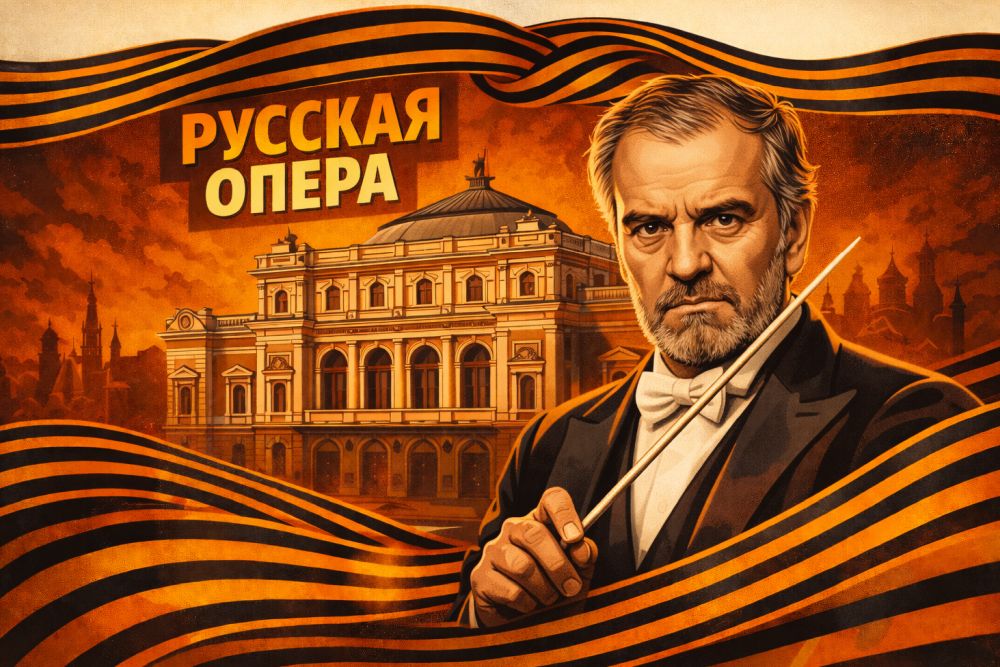
Valery Gergiev is the most powerful figure in Russian cultural policy (Visualisation: ChatGPT)
Valery Gergiev is the most powerful figure in Russian cultural policy (Visualisation: ChatGPT)
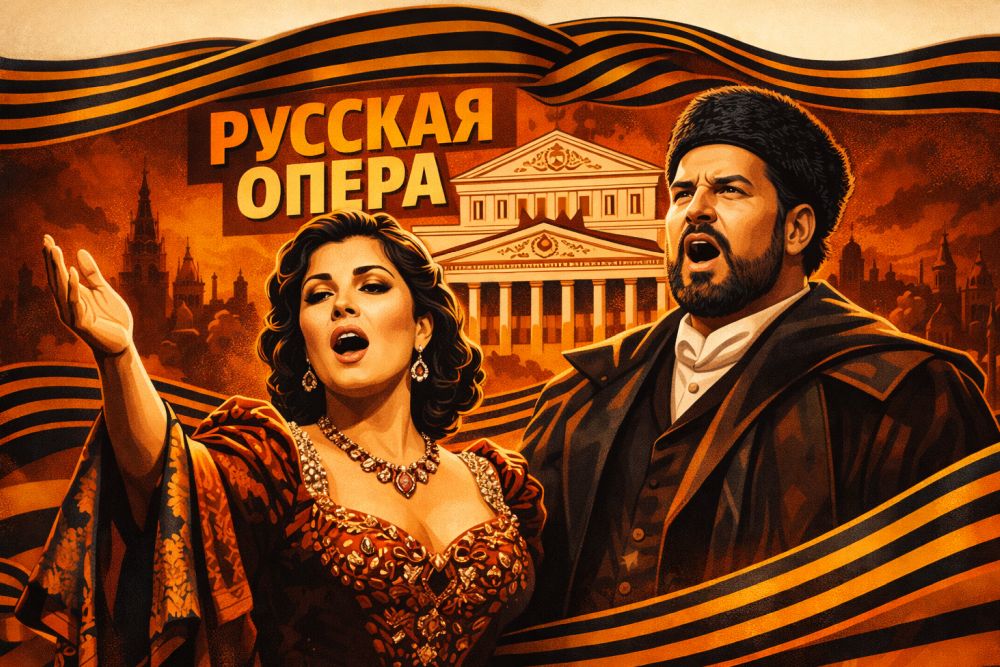
The presence of Russian opera stars loyal to the regime in the West is encouraged by the Russian authorities. Ildar Abdrazakov (right) has not performed in the West since research by Opern.News came to light; instead, he has been allowed to run an opera house on the Russian-occupied Crimea
The presence of Russian opera stars loyal to the regime in the West is encouraged by the Russian authorities. Ildar Abdrazakov (right) has not performed in the West since research by Opern.News came to light; instead, he has been allowed to run an opera house on the Russian-occupied Crimea
This photograph shows Valery Gergiev during the ‘Liberation Concert’ in the recently recaptured city of Palmyra (Syria) in 2016. It was published by the Russian Ministry of Defence – one wonders why?
This photograph shows Valery Gergiev during the ‘Liberation Concert’ in the recently recaptured city of Palmyra (Syria) in 2016. It was published by the Russian Ministry of Defence – one wonders why?