Olha-Kobyljanska Theatre, Chernivtsi
Opera as a Form of Survival
In western Ukraine, Dmytro Bortnianskyi’s «Creonte» — a nearly 250-year-old opera long thought lost — has returned to the stage. A cultural event with political resonance.
Willi Patzelt • 08. Oktober 2025
It is the cultural event of the year in Ukraine — and it reaches far beyond the significance of Dmytro Bortnianskyi’s first opera, premiered in Venice in 1776. For almost twelve years, Russia has been waging a war of aggression against Ukraine — since February 24, 2022, in an especially brutal and criminal form. War, wrote the Prussian military theorist Carl von Clausewitz (1780–1831) in his classic On War, is nothing other than — as so often quoted — “the continuation of politics by other means.”
Moral potential
The phrase sounds sober, but one easily overlooks how much is contained within it — and how little of it is mere theory today. In Ukraine, a war is raging that seeks not only to destroy territory but to obliterate meaning. Russia is waging this war not only against the Ukrainian people, but against their cultural heritage — against language, memory, and history, and thus against the foundations of what Clausewitz called “moral forces,” as opposed to “physical forces.”
The spirit of the troops, the will of the nation, and the education of its citizens ultimately decide victory or defeat. Culture, then, is not a decorative luxury but a factor of war. It shapes the moral ground on which a society’s capacity for action rests.
That an opera like «Creonte» is being staged now in the city of Chernivtsi (Ukrainian: Чернівці) — a city that has carried many identities within itself — is therefore far more than a cultural footnote. It is, in truth, an event of remarkable depth, revealing how closely war and culture are intertwined: the one destroys what the other holds together.
And the fact that this is also a cultural event of relevance to Western Europe is underscored by circumstance: a trip planned for the October 3 premiere was rendered impossible — most likely — by Russian drones over Munich Airport on the evening of October 2. The journey to Ukraine was only possible for the second performance, on October 5.
A Town of Many Mirrors
Western Ukraine’s Chernivtsi — once known as “Little Vienna” or “Jerusalem on the Pruth” — lies far from the frontlines, yet in the very spiritual center of this war. Even here, Russian missiles have struck and taken lives.
The town, the jewel of Bukovina and once a showcase of Habsburg urban culture, was for centuries a place where languages, religions, and empires met — without completely annihilating one another. Five opera troupes and ten newspapers once thrived here: Chernivtsi was a city of intellectual abundance. People spoke German and Romanian, Polish, Armenian, Yiddish, and Ruthenian (a precursor of Ukrainian) — and all of it was natural. Multilingualism was not a symptom of fragmentation but an expression of education, tolerance, and cosmopolitanism.
Today, as Ukraine once again fights for its cultural survival, Chernivtsi stands as a counter-model to the imperial monoculture that Moscow seeks to impose on parts of Europe. Here — where Franz Joseph I founded a German-speaking university in 1875, where the young Joseph Schmidt sang as a chazzan in the Israelite Temple, and where Paul Celan began to write in a mix of German and despair — one senses that culture is not ornament but a form of survival.
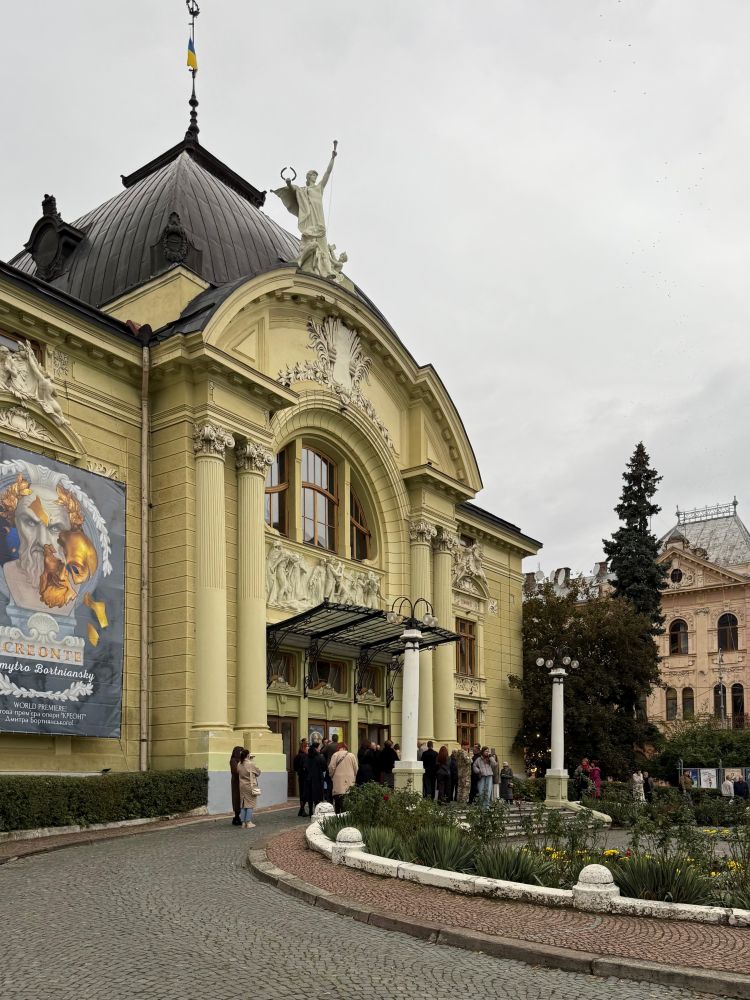
The same is true of the Olha-Kobyljanska Theatre. Opened in 1905 as a near twin of the Stadttheater in Fürth (Germany) and built by the Viennese architectural firm Fellner & Helmer, it still breathes the air of the Habsburg era: a small, bright sibling of Vienna’s Volkstheater, standing in a city whose streets now bear names like Shevchenko and Kobyljanska — witnesses of a Ukrainian self-affirmation that had to be fought for over centuries.
Dmytro Bortniansky — a Ukrainian (!) Opera Composer
Architecturally and acoustically, the theatre offers an experience perhaps not far removed from what Venetian audiences heard at the 1776 premiere of Bortniansky’s «Creonte» in the now-vanished Teatro San Benedetto. After the 1776/77 season, the opera was considered lost until 2020, when Ukrainian musicologist Olga Shumilina discovered the score in Lisbon’s Biblioteca da Ajuda.
A Russian musician had previously rediscovered it as well, but had failed to bring his version to the stage. A project announced in Vienna last year by the Orchester Wiener Akademie under Martin Haselböck, supported by the Ukrainian Institute, has likewise not yet materialized.
That the opera — following a concert performance in Kyiv in November 2024 — has now been staged in Ukraine for the first time since its rediscovery adds a further layer of meaning: it reclaims the work’s true origin. For those who knew of Bortniansky at all, he was long considered a Russian.
In fact, he was born in Hlukhiv, a town on the left bank of the Dnipro that only became part of the Russian Tsardom after the Treaty of Andrusovo ended the Russo-Polish War in 1667. A musical prodigy, the Ukrainian was sent to St. Petersburg, where he was trained primarily in sacred music — for there was no real Russian opera tradition at the time.
He is still best known for his Cherubim Hymns rather than his Italian operas. In the German-speaking world, his choral setting Ich bete an die Macht der Liebe (“I Worship the Power of Love”) has eclipsed the rest of his oeuvre — and continues to be played in the German Armed Forces’ Grand Tattoo (Großer Zapfenstreich), following the command “Helm ab zum Gebet!” (“Remove helmets for prayer!”).
A Little Mozart, a Little Bel Canto
From a musical perspective, Bortniansky could easily be placed a century later. «Creonte», by contrast, often sounds like uninspired Mozart touched with bel canto — solidly constructed, but lacking a distinctive signature. The score is expansive, the drama unfolds slowly, much of it remaining on the musical surface. Strong moments — and there are some — tend to drown in a sea of rather uniform numbers.
Performing the opera unabridged makes sense for a rediscovery, yet one quickly senses that some trimming would do it good. In a tighter version, the work could well unfold its potential and would likely appeal to Western opera houses.
The evening features three tenors — for the youthful roles once sung by castrati are difficult to cast today. Future productions would do well to reinterpret them as trouser roles for female voices. None of the three tenors fully convinced — but that can hardly be blamed on them. Many male musicians are at the front; others have fallen or gone into exile. That, too, is part of the evening’s truth: even a casting question can take on political weight.
Music and Its Circumstances
Herman Makarenko, conductor at the Kyiv National Opera and a “UNESCO Artist for Peace” (ironically listed alongside Valery Gergiev), stood before an ensemble with little stage experience — and an orchestra in the pit that is, in fact, the National Presidential Orchestra, a military ensemble.
And yet Makarenko managed this performance confidently — not without rough edges, but admirable under the circumstances. The evening was never primarily about musical perfection, but about a political act against silence. Makarenko was not only conducting a score — he was maintaining a fragile order: the order of art in the midst of war.
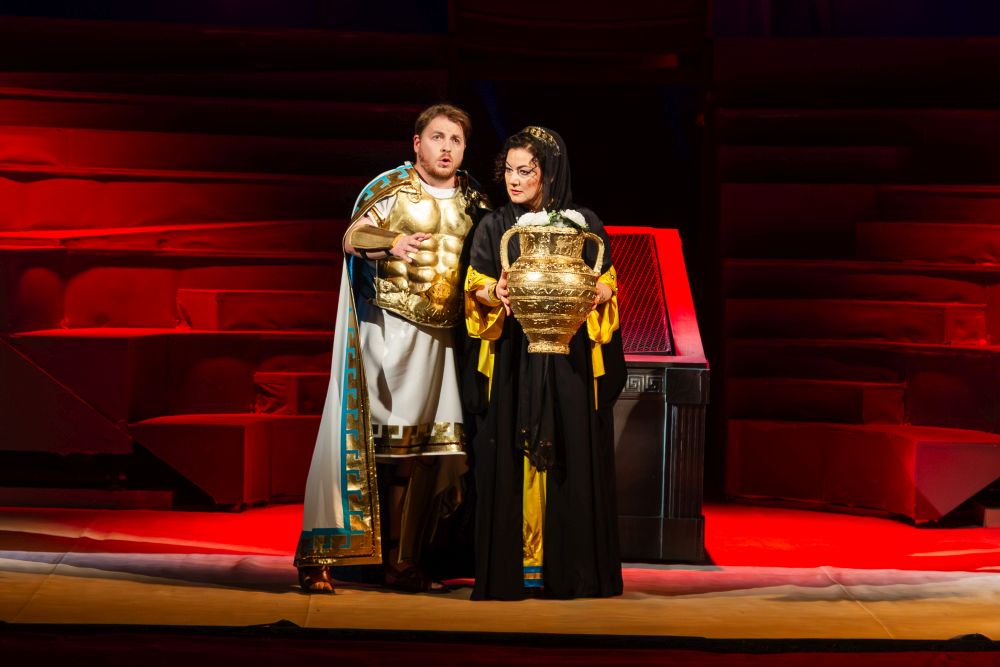
For, as people in Chernivtsi say, art helps them not to lose themselves in times of tyranny. Bortniansky’s «Creonte» fits this sentiment perfectly. It tells the ancient story of Antigone, who defies Creonte’s ban on burying Polyneikes. But unlike Sophocles, the opera ends differently: Antigone does not take her own life — the people of Thebes, outraged by Creonte’s cruelty, free her and proclaim her queen. In Ukraine in 2025, the meaning of that story needs no explanation.
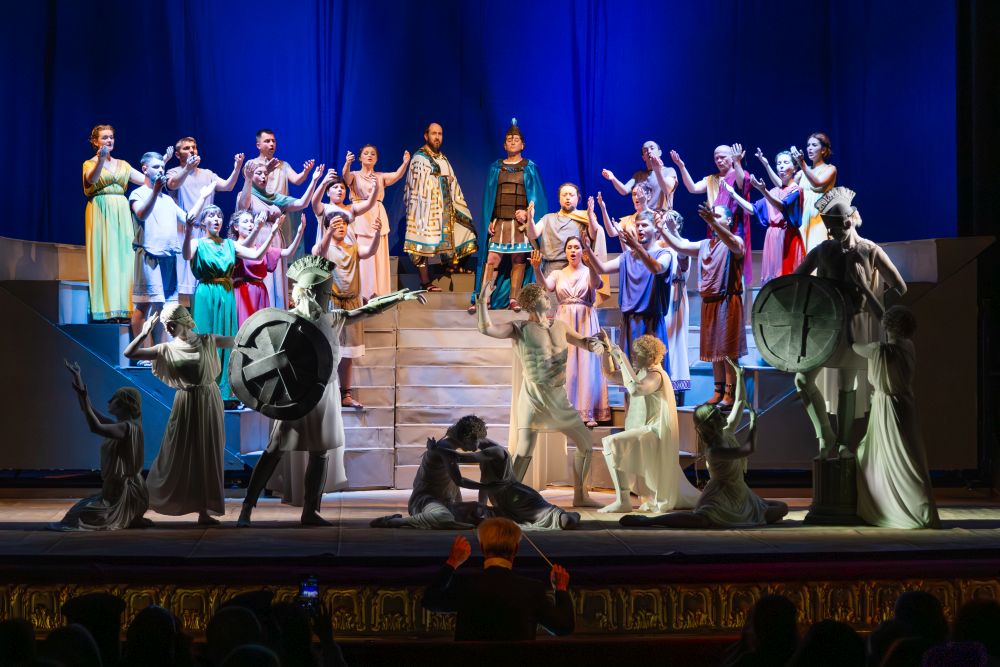
The production wisely avoids overt political references; the present intrudes on its own. With a stylized Greek theatre in the background, human embodiments of statues, and masks hanging from above, the production attempts to convey a certain timelessness, yet at times veers on the fine line between timelessness and blandness. Likewise, the costumes are occasionally reminiscent of scholastic play productions. It is fairly likely that this production will not be recorded in the operatic historical records. But art, in the end, is not measured by the quality of its appearance, but by the quality of its existence.
More Than a Performance
And thus, this evening in Chernivtsi reveals that something that transcends music and the scene: that culture is not merely an expression of a nation, but its very foundation. Here, in a theatre that still breathes the air of vanished empires, an opera long silenced for nearly two and a half centuries comes back to life. That it now resounds amid war feels less like an accident of music history than an answer to it — a reclaiming of voice and meaning.
A country that sings whilst war rages is not fighting any secondary battles, but rather defends that which holds it together. In the words of Carl von Clausewitz, this is “moral potential.”
«Creonte» — Dmytro Bortniansky
Olha-Kobyljanska City Theatre, Chernivtsi
This article was translated by Oksana Schocher from the original German version
On the topic
SPOTIFY
Recording of the concert premiere on November 11, 2024
The Olha-Kobyljanska City Theatre, built in 1905, still breathes the spirit of the Habsburg era
© Willi Patzelt
The Olha-Kobyljanska City Theatre, built in 1905, still breathes the spirit of the Habsburg era
© Willi Patzelt
The production featured a Greek theater and statues embodied by people – the present inevitably imposed itself
© Serhiy Bohun
The production featured a Greek theater and statues embodied by people – the present inevitably imposed itself
© Serhiy Bohun
It is also the love between Antigone and Haemon that breaks Creon’s power
© Serhiy Bohun
It is also the love between Antigone and Haemon that breaks Creon’s power
© Serhiy Bohun